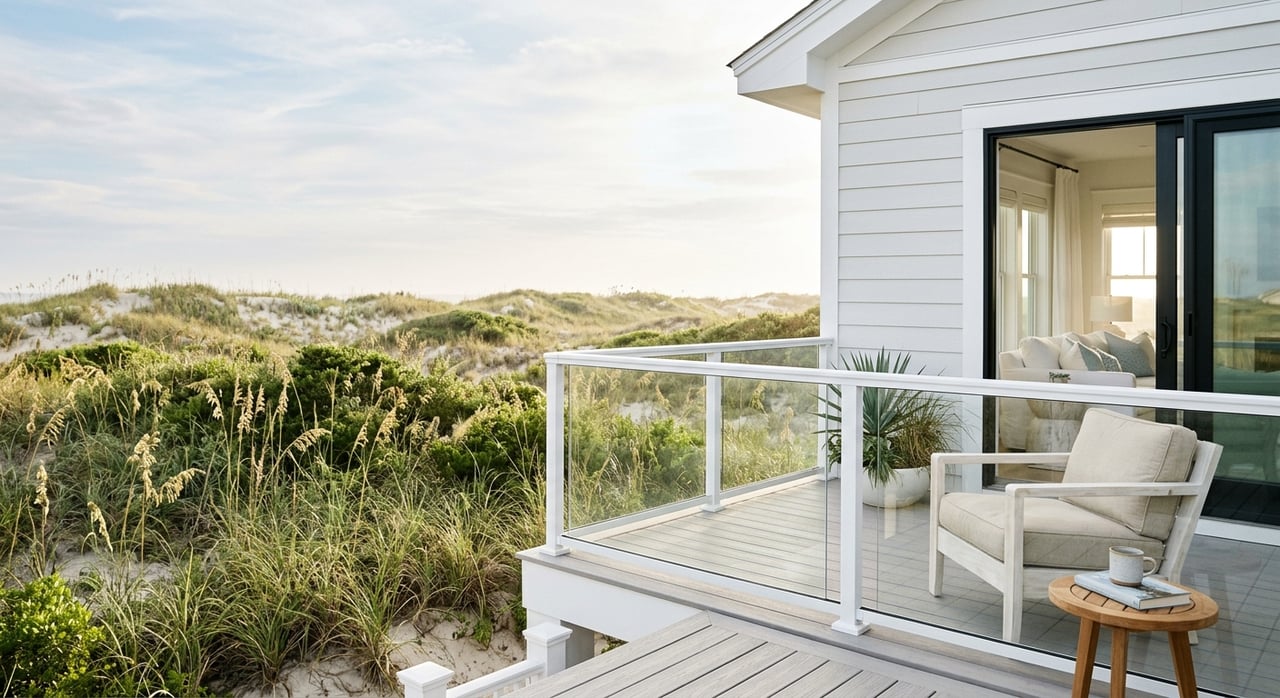
If you are weighing an oceanfront home against a soundside property in Dare County, you are really deciding what kind of value matters most to you. Some buyers want direct beach access and the classic Outer Banks experience, while others care more about a lower entry point, calmer water, or a different rental pattern. The good news is that each option can make sense when you match it to your goals. Let’s dive in.
What oceanfront and soundside mean
On the Outer Banks, location labels tell you a lot about both lifestyle and pricing. Oceanfront means the home sits directly on the beach side with direct frontage to the ocean, while semi-oceanfront usually means one lot back, often with a road or a row of homes between the house and the beach.
Soundfront homes border the sound directly, and soundside homes are nearby but not always directly on the water. In practical terms, oceanfront is the premium beach product, semi-oceanfront is the close-to-beach compromise, and soundside or soundfront is the quieter water-oriented alternative.
That difference matters because buyers in Dare County are not just choosing a house. You are choosing access, view type, exposure to coastal conditions, and the kind of ownership experience you want over time.
Dare County values in context
Dare County remains a high-priced coastal market by any measure. Public market data in March 2026 showed a countywide median sale price of $613,750 on Redfin, while Zillow reported a typical home value of $600,596 and a median sale price of $569,000.
Local MLS data paints a similar picture. The Outer Banks Association of REALTORS reported a first-quarter 2025 single-family median sales price of $621,250, with residential sales down 3% year over year and active inventory up 23% year over year.
That mix suggests a market that is still expensive, but with more breathing room than the tightest years of the pandemic-era surge. For you as a buyer or seller, that means frontage type can play a major role in value because the overall market already starts from a high baseline.
Why frontage drives price
Town-level data shows how much value can vary within Dare County. In first-quarter 2025, median sales prices were $870,000 in Nags Head, $750,000 in Southern Shores, $690,000 in Kitty Hawk, $655,000 on Hatteras Island, and $495,000 in Colington.
Those numbers do not isolate oceanfront from soundside, but they help explain the value ladder. In a market with meaningful price differences by town, water orientation and beach access can further widen the gap between one property and another.
In broad terms, oceanfront is typically the highest-priced tier. Semi-oceanfront usually avoids the full oceanfront premium, and soundfront or soundside often provides a more attainable way to buy into a water-oriented Outer Banks lifestyle.
Oceanfront value: premium access and premium costs
Oceanfront homes hold strong appeal because the value proposition is simple and easy to understand. You get direct beach access, open ocean views, and the kind of location that many vacationers and second-home buyers picture first when they think about the Outer Banks.
That clear positioning often supports strong peak-season rental appeal as well. For owners thinking about vacation rental use, oceanfront has the most obvious marketing story and usually the strongest summer demand profile.
But that premium comes with tradeoffs. Oceanfront ownership is often more exposed to erosion concerns, beach nourishment timing, and insurance complexity than homes farther from the beach.
Dare County specifically advises buyers to ask about flood hazards, erosion history, and insurance before purchasing. The county also notes that standard homeowners insurance does not cover flood damage, so a separate flood policy is needed.
Soundside value: a different kind of waterfront appeal
Soundside and soundfront homes speak to a different buyer and guest experience. Instead of surf and direct beach frontage, the draw is often open sunsets, calmer water, and activities like kayaking, crabbing, fishing, and kiteboarding.
For many buyers, that creates a compelling value equation. You may gain water access or water views at a lower cost than an oceanfront purchase, while also stepping into a quieter ownership experience.
From a rental perspective, soundfront may not always match oceanfront in peak-week upside, but it can be competitive in shoulder seasons and for niche guest demand. Rental descriptions for the Outer Banks also note that soundfront rates tend to decline more gradually in the fall and spring than oceanfront rates.
That matters if you are thinking beyond just the hottest summer weeks. A soundside property may appeal to guests who want flexibility, water sports, and a less beach-crowded atmosphere during more of the year.
Semi-oceanfront: the middle ground many buyers like
If you want to stay close to the beach without paying full oceanfront pricing, semi-oceanfront can be a smart middle path. These homes are typically one lot back from the ocean and may still offer water views and an easy walk to the beach.
For many buyers, this is where value and lifestyle meet most cleanly. You keep much of the beach appeal while lowering the acquisition cost compared with direct oceanfront.
That same balance can matter for rental performance too. Semi-oceanfront often offers a strong mix of proximity, guest appeal, and lower basis, which is why many buyers see it as a practical compromise in the Outer Banks market.
Rental demand is strong, but seasonal
Tourism remains the economic engine of Dare County. The Outer Banks Visitors Bureau said visitor spending surpassed $2.1 billion in 2024, tourism generated more than $147.1 million in state and local tax revenue, and the industry supported 12,260 jobs, or 45.5% of all jobs in the county.
That level of visitor activity supports vacation-home demand, but it does not mean every frontage type performs the same way all year. Countywide short-term lodging occupancy was 36.6% in 2024, with average daily rate at $411.64 and gross occupancy revenue at $786.1 million.
The 2025 forecast showed similar conditions, with projected occupancy of 37.1% and ADR of $407.02. The biggest takeaway is seasonality: occupancy is heavily weighted toward summer, with third-quarter occupancy around 69% compared with roughly 10% in the first quarter.
For owners and investors, this is where property type matters. Oceanfront often captures the clearest peak-season demand, while soundside and soundfront can serve different guest preferences outside the summer peak.
Costs can change the value equation fast
A home’s purchase price is only part of the story in Dare County. Holding costs, insurance, and tax treatment can quickly shift what looks like the better value on paper.
Dare County notes that flood insurance has a 30-day waiting period and that pricing varies by flood zone, elevation, and the age of the structure. The county also explains that unincorporated Dare County is currently a Class 6 CRS community, which means a 20% discount on eligible flood policies.
If you are comparing an older oceanfront cottage with a newer soundside home, those details can be meaningful. The county distinguishes between PRE-Firm and POST-Firm structures, which can be especially important when evaluating older beach houses.
Short-term rental taxation also matters. Dare County’s occupancy tax rate is 6% of gross receipts for transient lodging, although the tax does not apply to a private residence or cottage rented for fewer than 15 days in a calendar year or to stays of 90 or more continuous days.
Beach nourishment is part of oceanfront ownership
If you are looking at oceanfront property, beach nourishment should be part of your decision-making process. Dare County says no nourishment projects were scheduled for 2025, but projects are planned for Avon, Buxton, and Nags Head in 2026, and for Duck, Southern Shores, Kitty Hawk, and Kill Devil Hills in 2027.
The county also notes that its Beach Nourishment Fund is supported by a 2% occupancy tax dedicated to beach widening and erosion mitigation. That does not mean every oceanfront purchase is a problem property, but it does mean beach conditions and project timing are part of the ownership picture.
Compared with that, soundside ownership may feel simpler in some cases. Soundside homes can still face flood-related issues, but they generally are not tied to dune conditions and beach renourishment schedules in the same direct way.
Which option offers better value for you?
The best value depends on what you want the property to do for you. There is no single winner across all buyers because lifestyle, carrying costs, and income goals all shape the answer.
If your priority is prestige, direct beach access, and the strongest summer rental story, oceanfront may justify the higher price and higher complexity. If you want proximity to the beach with a more balanced acquisition cost, semi-oceanfront can be a strong play.
If you value calmer water, sunsets, a quieter setting, or a lower-cost path into a waterfront-oriented property, soundside or soundfront may offer the better fit. In many cases, the smartest move is not chasing the most famous location label, but choosing the frontage type that best supports your long-term use of the home.
A local-first way to compare properties
In the Outer Banks, frontage is only one part of the value story. Town, elevation, flood zone, structure age, beach access, condition, and intended use all influence what a property is really worth to you.
That is why broad market trends are helpful, but property-level review matters most. A native, local perspective can help you compare not just asking prices, but also the real ownership experience behind an oceanfront, semi-oceanfront, or soundside address.
Whether you are buying a second home, a vacation rental, or your next long-term coastal property, the right comparison starts with your goals and ends with local context. If you want help evaluating which frontage type offers the best fit in Dare County, connect with Brad Beacham for a thoughtful, property-by-property conversation.
FAQs
What is the difference between oceanfront and soundside homes in Dare County?
- Oceanfront homes sit directly on the beach side with direct ocean frontage, while soundside homes are located near the sound and may or may not be directly on the water.
Are soundside homes usually less expensive than oceanfront homes in the Outer Banks?
- In general, yes. The market typically treats oceanfront as the premium tier, while soundfront and soundside are usually more affordable than direct oceanfront.
Is semi-oceanfront a good value in the Outer Banks market?
- For many buyers, yes. Semi-oceanfront homes often offer a strong balance of beach proximity, guest appeal, and lower purchase cost than oceanfront properties.
Do oceanfront homes in Dare County have higher ownership risks?
- They can. Dare County advises buyers to review flood hazards, erosion history, and insurance closely, and oceanfront homes are generally more exposed to beach and dune-related issues.
How seasonal is vacation rental demand in Dare County?
- Very seasonal. County lodging data shows occupancy is heavily concentrated in summer, with much stronger third-quarter performance than first-quarter performance.
What taxes should vacation rental owners know in Dare County?
- Dare County charges a 6% occupancy tax on gross receipts for transient lodging, with limited exceptions for certain short rental durations and longer continuous stays.