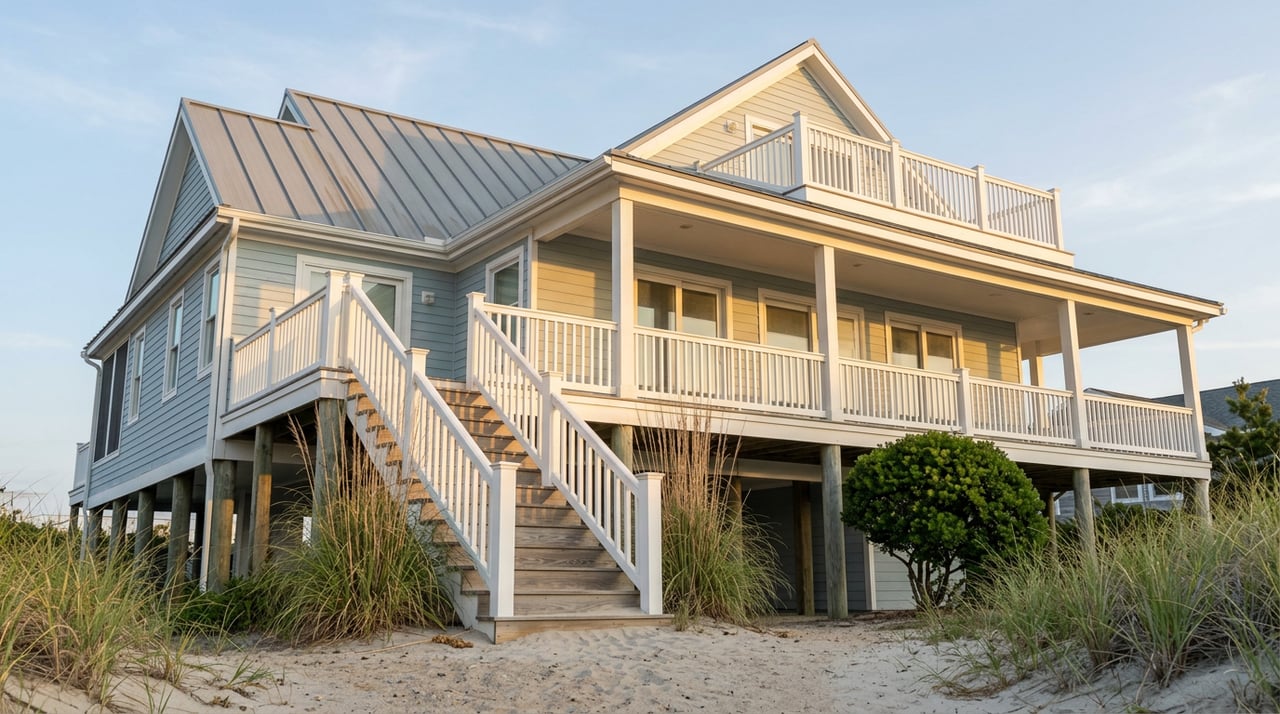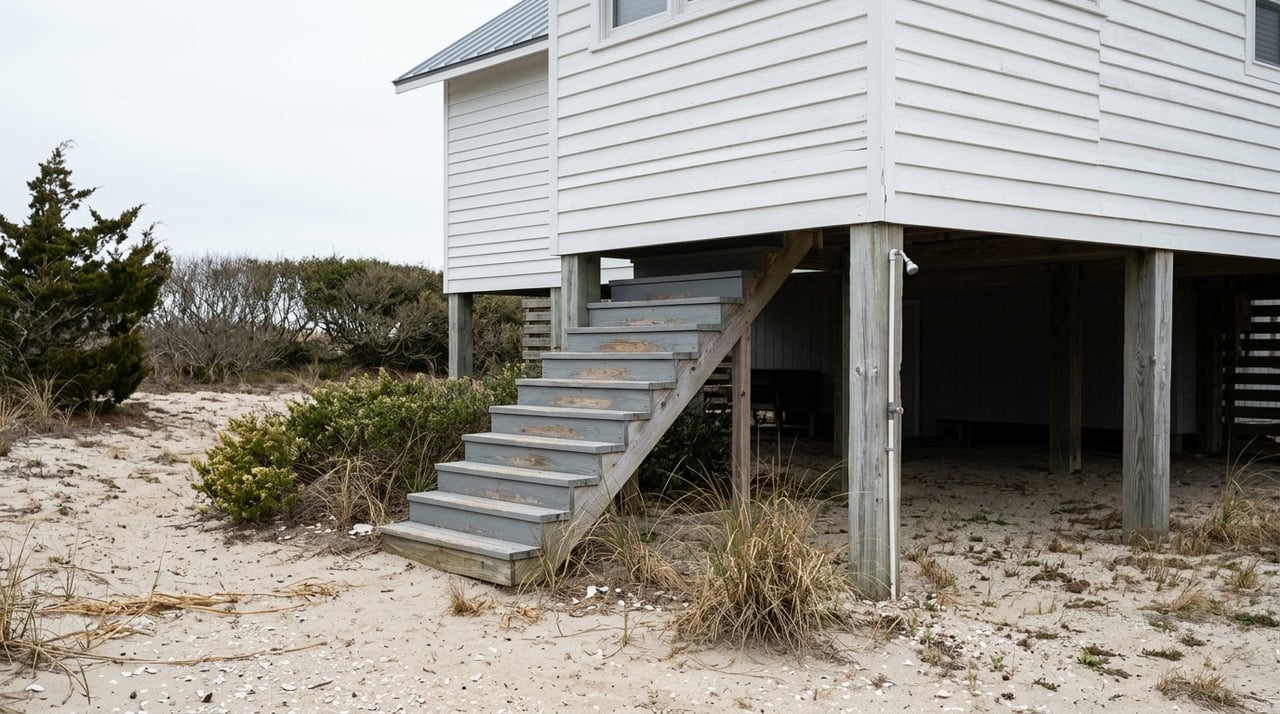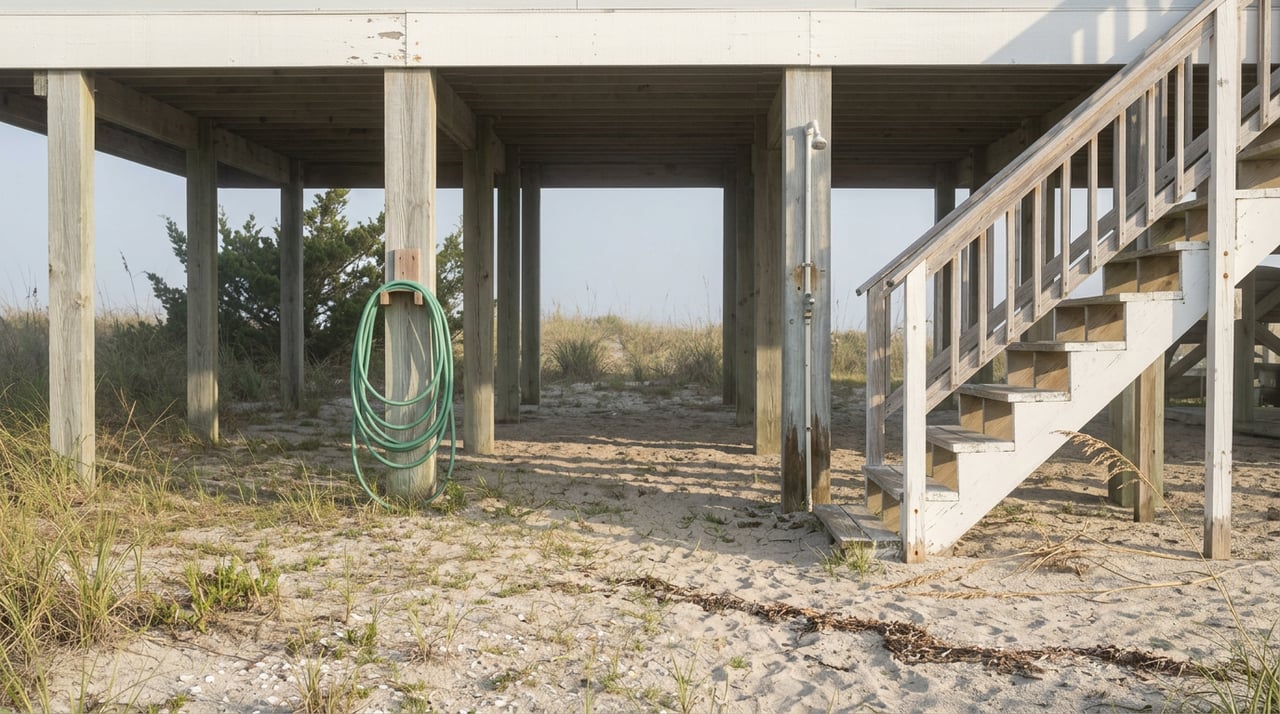
Drive south through Rodanthe and Waves on NC 12 and the businesses thin out fast. By the time you cross into Salvo, the storefronts have all but disappeared. No sit-down restaurant. No grocery store. Just a scattering of houses set back from the road, a couple of buildings that seem to do six jobs at once, and then eleven and a half miles of nothing but the National Seashore.
Every other Outer Banks town solved this problem the same way over the last thirty years: more restaurants, more retail, more reasons for a visitor's car to stop moving. Salvo took a different path, and it wasn't an accident of geography. The village is under a square mile. It could have built a strip. It didn't. What it built instead were three institutions that quietly absorbed the functions a downtown would have handled, and all three are still doing that work today.
The Village That Kept Its Footprint Small on Purpose
Salvo sits at the southern end of what locals call the Tri-Villages, the string of Rodanthe, Waves and Salvo that runs together so seamlessly that a local legend claims visitors used to steal the "Welcome to Waves" sign just to prove they'd found the boundary. Salvo is the quietest of the three, and it has stayed that way while the rest of Hatteras Island filled in around it.
The numbers tell the story better than the adjectives do. Within the village limits there are two sports-and-tackle outlets, two convenience stores, and one art gallery. That's the commercial district. For a real grocery run or a sit-down meal, residents point their cars south to Avon, about a fifteen-minute drive, or north into Rodanthe and the rest of the Tri-Villages strip.
That's not a village that ran out of room to grow. It's a village where the growth that happened elsewhere on the island simply didn't happen here, and the people who live in Salvo built their week around that fact instead of fighting it.
The Gallery That Does More Than Sell Art
The most recognizable building in town isn't a restaurant or a store. It's Pea Island Art Gallery, a shop built to echo the look of the 1870s life-saving stations that once anchored villages like Salvo up and down this stretch of coast. It sits near the Salvo Day Use Area, hard to miss from NC 12, and it has represented more than 100 East Coast artists in every medium from pottery to hand-tinted photography for well over two decades under owner Kim Robertson.
Robertson didn't set out to build a landmark. She told Our State magazine that one visit to Hatteras Island was enough to convince her she had to live here.
"I just knew I had to live here. It was magic."
What she built ended up functioning as something closer to a community living room than a retail stop. Regulars who return to the island every summer make a point of stopping in to say hello before they leave, the same way they'd check in with a neighbor. In a village with no coffee shop and no diner counter, that kind of recurring, face-to-face contact matters more than square footage suggests. The gallery isn't incidental to Salvo's social life. For a lot of residents and longtime visitors, it is Salvo's social life.
Two Stores, Six Jobs
If the gallery covers culture, Salvo's two combination convenience and tackle stores cover almost everything else. Walk into either one and you'll find bait, rods and reels, beer and wine, gourmet coffee, beach supplies, firewood, propane, souvenirs, boogie boards, and an ATM, all under one roof. One of them also serves as an official weigh station for anglers and sells North Carolina fishing licenses on the spot.
That combination isn't unusual for a small Hatteras Island village. What's notable is how much civic weight it carries in a place this size. Consider what these two stores are actually doing for the village:
- Functioning as the only retail anchors within Salvo's limits
- Serving as the meeting point for anglers coming off the water, since one doubles as the official catch weigh station
- Selling state fishing licenses on site, so a trip to the sound doesn't require a separate errand
- Keeping enough of the basics in stock that residents rarely need an emergency run to Avon
- Acting as the informal bulletin board and gathering spot a downtown coffee shop would otherwise provide
Salvo used to have a formal answer to this problem. From 1901 until it was decommissioned in 1988, the village's tiny post office, at roughly 8 by 10 feet, held the title of Smallest Post Office, small enough that visitors regularly mistook it for a restroom. A replica still stands along NC 12. But the informal role that little building played, the place where you ran into everyone in town on a given morning, didn't disappear when it closed. It just moved down the road to the tackle counter.
Wednesdays Belong to Waves
Salvo residents who want a farmers market don't have to wait for one to open in the village, because it never will. Instead, they drive a few minutes north to Camp Hatteras in Waves, where the Tri-Villages Market sets up every Wednesday from 9 a.m. to 2 p.m. The market is now in its fourth year, and for the 2026 season it's running through October 14, bringing in local artists, food vendors and small makers from across the region, according to Island Free Press.
This is the pattern that defines Salvo more than any single business does. Old Christmas, the island's January tradition of oyster roasts, tall tales, and the arrival of the folkloric bull Old Buck, is hosted at the Rodanthe-Waves-Salvo Community Building even though it carries all three village names. The market runs in Waves. The bigger grocery trip happens in Avon. Salvo is written into the region's shared calendar, but it rarely hosts the anchor event itself. Residents here have effectively outsourced the commercial and civic infrastructure to their neighbors, keeping their own square mile as quiet as it's ever been.
What the Quiet Actually Buys You
None of this reads as a shortage once you understand what it's trading for. South of the village limits, an eleven and a half mile stretch of Cape Hatteras National Seashore runs uninhabited, with the Salvo Day Use Area providing the last real access point, complete with restrooms, changing facilities, picnic tables and grills. It's one of the better sunset spots on the island precisely because there's nothing built up around it to get in the way.
That trade shows up in the village's history too. Long before the gallery or the tackle shops existed, Salvo had its own life-saving station, Gull Shoal, which operated from 1878 to 1940. In 1899, a surfman from that station named Rasmus Midgett single-handedly rescued ten people from the wreck of the Priscilla, working the surf alone because no one else was close enough to help in time. A few miles north in Rodanthe, the Chicamacomico Life-Saving Station Historic Site still stands as a working museum, and it hosts an annual living-history day marking one of the service's most celebrated rescues, the Mirlo. Salvo residents make that short drive north the same way they make the drive to the Wednesday market, treating village lines as far more porous than the map suggests.
Salvo never needed a Main Street to have a real community. It built two stores that do the job of six, kept one gallery running long enough that regulars consider the owner a friend, and let its neighbors carry the market and the parade. What's left in the village itself is the part that mattered most from the start: a quiet stretch of sand that eleven and a half miles of protected seashore keeps that way on purpose.
If you're a longtime Salvo owner curious what that kind of quiet is worth in today's market, or you're weighing a move somewhere else on Hatteras Island where the pace is a little different, the Brad Beacham Group knows this stretch of coast the way a neighbor does. Get Your Instant OBX Home Valuation whenever you're ready to see where your Salvo property stands.